


The public comment period on the Trump administration’s proposal to repeal the 2001 Roadless Area Conservation Rule closed on October 6, and the response was overwhelming.
Conservation organizations tracking participation report that more than 1 million comments and signatures were submitted in support of keeping the Roadless Rule in place during the 2026 comment period alone. Combined with approximately 600,000 comments submitted during an earlier 2025 comment period, at least 1.6 million comments have now been submitted in support of protecting America’s backcountry forests.
Here on the Central Coast, thousands of people added their voices to that national response. Los Padres ForestWatch spent the comment period helping residents understand what was at stake, hosting six town halls throughout the region—including a virtual event that you can watch anytime—submitting formal comments, and working alongside conservation organizations, outdoor businesses, and community partners to defend protections for roadless lands.
For Los Padres National Forest, the stakes are substantial: 37 inventoried roadless areas encompassing 635,106 acres across Santa Barbara, Ventura, San Luis Obispo, Kern, and Monterey counties.
Now that the comment period has closed, the question is what the U.S. Forest Service will do with what it heard.
What the Roadless Rule protects
Adopted in 2001, the Roadless Rule generally prohibits new road construction and most commercial logging across more than 44 million acres of inventoried roadless areas in national forests nationwide, excluding Colorado and Idaho, which operate under state-specific roadless rules. Roadless areas are generally off-limits to extractive industries like oil drilling and mining.

These landscapes include some of the largest remaining intact areas of national forest land outside designated wilderness. They provide habitat for wildlife, protect watersheds and drinking water sources, offer opportunities for hiking, biking, horseback riding, hunting, fishing, and other forms of quiet recreation, and help keep large areas of public land from becoming fragmented by new roads.
The Forest Service’s proposal would rescind the national Roadless Rule and instead leave future management of these areas largely to individual forest plans and site-specific decisions.
The agency has argued that repeal would give local forest managers greater flexibility and help address wildfire risk.
ForestWatch and other conservation organizations have challenged that rationale, pointing out that the Roadless Rule already allows wildfire suppression, prescribed fire, hazardous fuels reduction, and other management activities. They have also pointed to concerns that additional road access can increase human-caused wildfire ignition risk while contributing to invasive species spread, habitat fragmentation, erosion, and other impacts.
What the public comments show
The scale of public participation is significant, but understanding the numbers requires some context.
The Forest Service’s online docket currently contains 370,238 publicly posted comments. That figure does not necessarily represent every individual comment, postcard, petition signature, or organizational submission sent to the agency.
According to the Center for Western Priorities, many submissions arrive as attachments containing hundreds or thousands of individual names. In its analysis, the Center downloaded 17,857 attachments associated with 3,924 comments; those files represented an estimated 296,000 additional individual comments or signatures.
Meanwhile, conservation organizations tracking submissions through their own advocacy platforms report that more than 1 million comments opposing repeal were submitted during the 2026 comment period.
The Center for Western Priorities analyzed all 370,238 comments publicly available on Regulations.gov as of October 7.
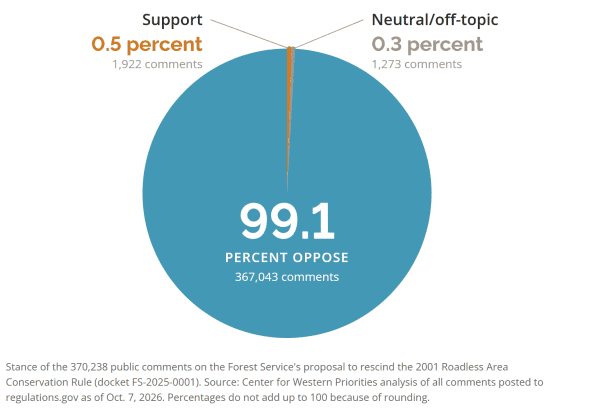
Its findings were striking:
- 99.1% opposed repealing the Roadless Rule
- 0.5% supported repeal
- 0.3% were neutral or off-topic
In total, the analysis classified 367,043 publicly posted comments as opposing repeal, compared with 1,922 supporting it.
Commenters raised concerns about wildlife habitat and migration corridors, drinking water and watersheds, quiet recreation, invasive species, and wildfire risks associated with increased road access.
The level of opposition is notable in historical context. When the Roadless Rule was originally adopted in 2001, roughly 95% of public comments supported establishing the protections. The share of publicly posted comments opposing repeal today is even higher.
The Central Coast showed up
ForestWatch was proud to be part of the nationwide effort, and proud of how strongly Central Coast communities participated.
Over the course of the campaign, ForestWatch:
- helped generate more than 1,400 public comments opposing repeal;
- mailed more than 550 postcards to decision-makers;
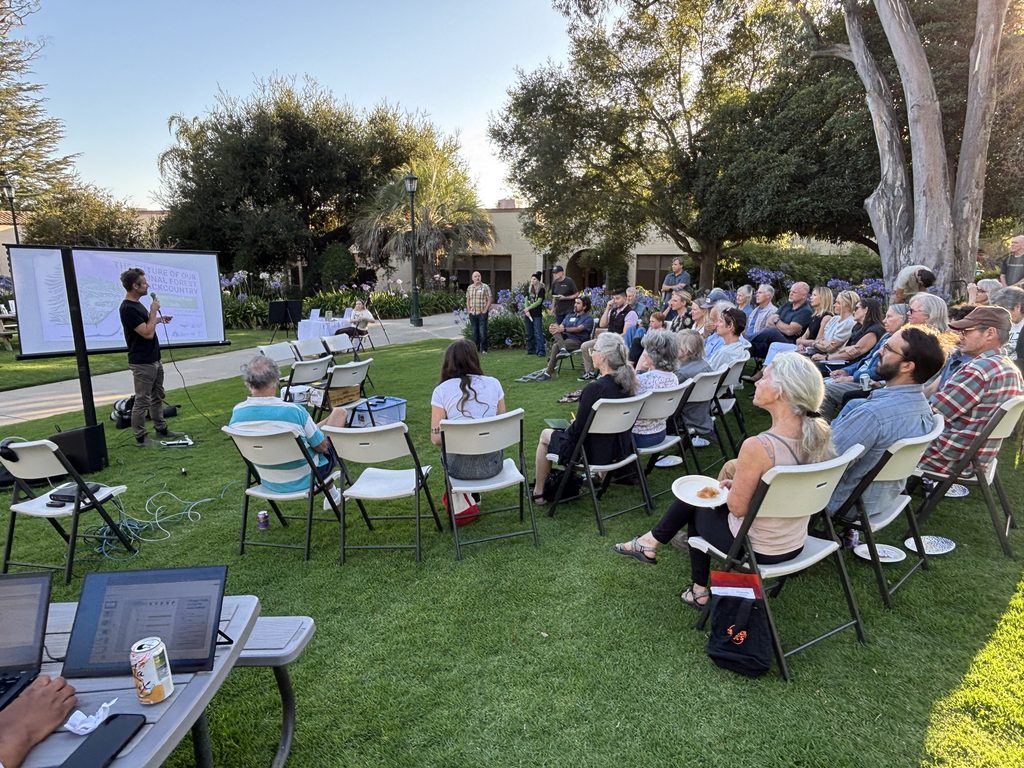
- hosted six town halls across the region to explain what the Roadless Rule does and help people participate in the federal comment process; and
- submitted an official letter signed by 23 Central Coast organizations supporting continued roadless protections.
Elected officials at the federal, state, and local levels also voiced strong support for the Roadless Rule. California Senators Alex Padilla and Adam Schiff co-led a congressional letter defending the rule, while Representatives Julia Brownley, Salud Carbajal, Jimmy Panetta, and Zoe Lofgren signed onto two separate congressional letters opposing the proposed repeal. At the state level, ForestWatch mobilized the California Legislative Central Coast Caucus—including Senate President pro Tempore Monique Limón, Senator John Laird, and Assemblymembers Dawn Addis, Steve Bennett, and Gregg Hart—to submit a letter opposing the rollback. The California Natural Resources Agency (CNRA), Santa Barbara County Supervisor Joan Hartmann, and the cities of Ojai and Thousand Oaks also weighed in against the repeal.
The effort extended well beyond individual comments and local organizing.
ForestWatch joined conservation groups from across the country in submitting a 250-page technical letter detailing concerns with the proposed repeal and the federal government’s environmental analysis. That administrative record matters not only to the Forest Service’s decision-making process, but also because it can help establish the technical and legal foundation for a potential challenge if the administration ultimately moves forward with repeal.
The outdoor business community weighed in as well. 127 outdoor businesses signed a letter supporting the Roadless Rule, including Patagonia, Toad&Co, Utu Skincare, and REI, underscoring the importance of intact public lands to recreation and the outdoor economy.
What happens now?
The Forest Service must now review the public record and determine whether—and how—to move forward with the proposed repeal. The administration could finalize the proposal, modify it, or change course.
If the administration moves ahead with eliminating the Roadless Rule, conservation organizations will review the final decision closely and evaluate all options to keep the rule in place. The detailed scientific, technical, and legal comments submitted during the public process will be an important part of that review.
The public has now spoken on an extraordinary scale.
To everyone who submitted a comment, signed a postcard or petition, attended a town hall, shared information with friends, or otherwise participated in this process: thank you.
ForestWatch will be monitoring the Forest Service’s next steps closely, and will continue working to defend the roadless landscapes, clean water, wildlife habitat, and backcountry that make Los Padres so remarkable.